Six Days, Two Rate Hikes, One Pipeline: Markets Between 14–18 September 2026
New here?
Start with how the market got here — thirty seconds is enough.
→
A drone strike on a pipeline in Saudi Arabia on the 11th of September set off a chain that, within a week, had two of the world's most powerful central banks raising interest rates for the first time in years. This is what that week did to every corner of the board — India, the world, and the year sitting underneath both.
The East-West Crude Oil Pipeline was the last major overland route letting Saudi oil bypass a Strait of Hormuz that has been effectively closed since February. Its shutdown pushed Brent to its highest levels since that war began. Two days later, the US Federal Reserve delivered its first hike since July 2023 — a unanimous 25 basis points to 3.75-4 percent — with Chairman Kevin Warsh naming Middle East tensions directly as one of three reasons. The Bank of Japan followed Friday, taking its own rate to 1.25 percent, the highest since 1995, on a split vote.
What actually moved markets wasn't the hikes themselves — both were fully priced in. It was the US 10-year Treasury yield breaking above 5 percent for the first time since 2007. The Dow fell 2.09 percent on the week despite Wall Street knowing exactly what the Fed would do.
India: a quiet week hiding two opposite years
Nifty 50 closed the week at 23,346, down 0.22 percent. Bank Nifty fell 0.44 percent, Sensex 0.65 percent — a calm surface. FMCG and Pharma did what defensives do in a nervous week, up 0.92 and 0.67 percent. The public sector basket was the clear loser: CPSE down 1.69 percent, PSE down 0.94 percent, with nothing in this week's government releases pointing to a specific cause — a yield story, not a policy one.
Pulled back to the first of January, the picture inverts. Nifty IT is down 24.41 percent year to date. FMCG is down 15.36 percent. Every large-cap benchmark in the country sits in the red for 2026. At the same time, every smallcap and midcap tier is green — Smallcap 50 up 15.73 percent, Metal up 15.96, Pharma leading everything at plus 18.02. One index number never shows you that both of these are true at once.
The rest of the board
Nasdaq is up 13.53 percent for the year even as the 10-year yield climbed nearly 20 percent in yield terms — the exact tension that broke this week. Nikkei leads every major global index at plus 23.74 percent YTD. Brent is up 64.46 percent since January — a single number that is the whole story of 2026. Gold has kept pace with the anxiety, up 14.49 percent on MCX; silver, usually the more volatile of the pair, has actually lagged this year at plus 2.41 percent, even after jumping 3.06 percent in just the last five trading days. The rupee has weakened 6.40 percent against the dollar since January, most of that pressure coming straight from the price of imported oil.
What came out of Delhi that actually mattered
Of roughly a hundred government releases this week, a handful carried real weight: India's August CPI and provisional WPI on the 14th, exports for April-August running 15.55 percent ahead of last year at 399.27 billion dollars, the EPFO wage ceiling raised to 25,000 rupees, the sugar stockholding limit eased from 15 to 30 days, and Semicon India 2026 launching the country's chip-manufacturing roadmap. Most of the rest, across every ministry, was routine government housekeeping.
Ahead
Flash PMIs land midweek across the US, Germany, the Eurozone and the UK. The Bank of Japan publishes its meeting minutes Friday, explaining this week's split vote. The Ministry of Steel holds an open house on import issues on the 24th — worth watching, since Metal was one of the very few sectors that actually gained this week.
Full weekly and year-to-date numbers for every index, sector and asset class referenced above are attached below.
This is commentary only. Nothing here is a buy/sell call or a recommendation — no derivatives, no positions suggested. For any personal investment decision, please consult a SEBI-registered adviser.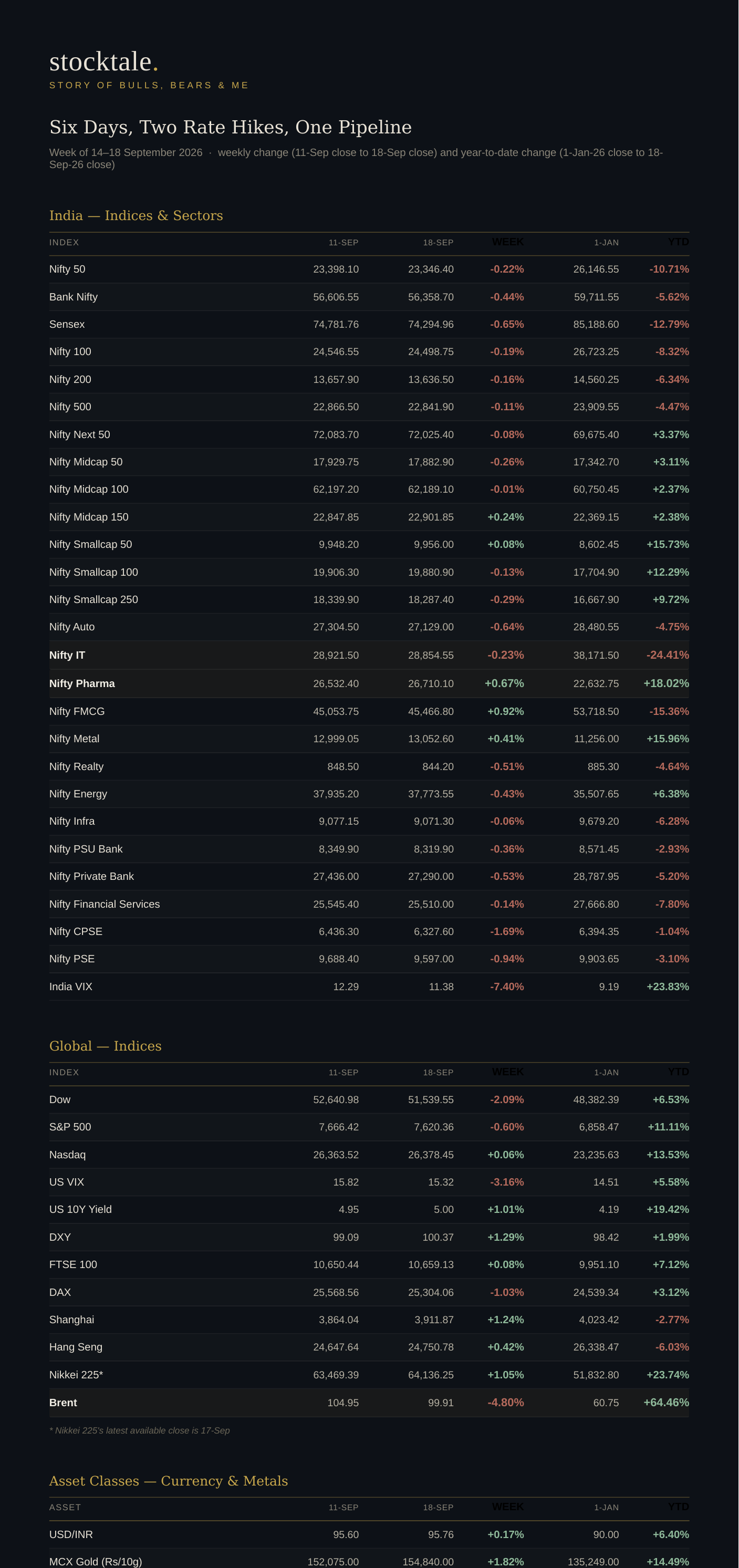
The East-West Crude Oil Pipeline was the last major overland route letting Saudi oil bypass a Strait of Hormuz that has been effectively closed since February. Its shutdown pushed Brent to its highest levels since that war began. Two days later, the US Federal Reserve delivered its first hike since July 2023 — a unanimous 25 basis points to 3.75-4 percent — with Chairman Kevin Warsh naming Middle East tensions directly as one of three reasons. The Bank of Japan followed Friday, taking its own rate to 1.25 percent, the highest since 1995, on a split vote.
What actually moved markets wasn't the hikes themselves — both were fully priced in. It was the US 10-year Treasury yield breaking above 5 percent for the first time since 2007. The Dow fell 2.09 percent on the week despite Wall Street knowing exactly what the Fed would do.
India: a quiet week hiding two opposite years
Nifty 50 closed the week at 23,346, down 0.22 percent. Bank Nifty fell 0.44 percent, Sensex 0.65 percent — a calm surface. FMCG and Pharma did what defensives do in a nervous week, up 0.92 and 0.67 percent. The public sector basket was the clear loser: CPSE down 1.69 percent, PSE down 0.94 percent, with nothing in this week's government releases pointing to a specific cause — a yield story, not a policy one.
Pulled back to the first of January, the picture inverts. Nifty IT is down 24.41 percent year to date. FMCG is down 15.36 percent. Every large-cap benchmark in the country sits in the red for 2026. At the same time, every smallcap and midcap tier is green — Smallcap 50 up 15.73 percent, Metal up 15.96, Pharma leading everything at plus 18.02. One index number never shows you that both of these are true at once.
The rest of the board
Nasdaq is up 13.53 percent for the year even as the 10-year yield climbed nearly 20 percent in yield terms — the exact tension that broke this week. Nikkei leads every major global index at plus 23.74 percent YTD. Brent is up 64.46 percent since January — a single number that is the whole story of 2026. Gold has kept pace with the anxiety, up 14.49 percent on MCX; silver, usually the more volatile of the pair, has actually lagged this year at plus 2.41 percent, even after jumping 3.06 percent in just the last five trading days. The rupee has weakened 6.40 percent against the dollar since January, most of that pressure coming straight from the price of imported oil.
What came out of Delhi that actually mattered
Of roughly a hundred government releases this week, a handful carried real weight: India's August CPI and provisional WPI on the 14th, exports for April-August running 15.55 percent ahead of last year at 399.27 billion dollars, the EPFO wage ceiling raised to 25,000 rupees, the sugar stockholding limit eased from 15 to 30 days, and Semicon India 2026 launching the country's chip-manufacturing roadmap. Most of the rest, across every ministry, was routine government housekeeping.
Ahead
Flash PMIs land midweek across the US, Germany, the Eurozone and the UK. The Bank of Japan publishes its meeting minutes Friday, explaining this week's split vote. The Ministry of Steel holds an open house on import issues on the 24th — worth watching, since Metal was one of the very few sectors that actually gained this week.
Full weekly and year-to-date numbers for every index, sector and asset class referenced above are attached below.
This is commentary only. Nothing here is a buy/sell call or a recommendation — no derivatives, no positions suggested. For any personal investment decision, please consult a SEBI-registered adviser.
Never one of the nine.
Learn to read the market yourself — Arthashastra through the week, Ranbhoomi every Friday evening, live sessions in Patha-Shala.
Write today’s →